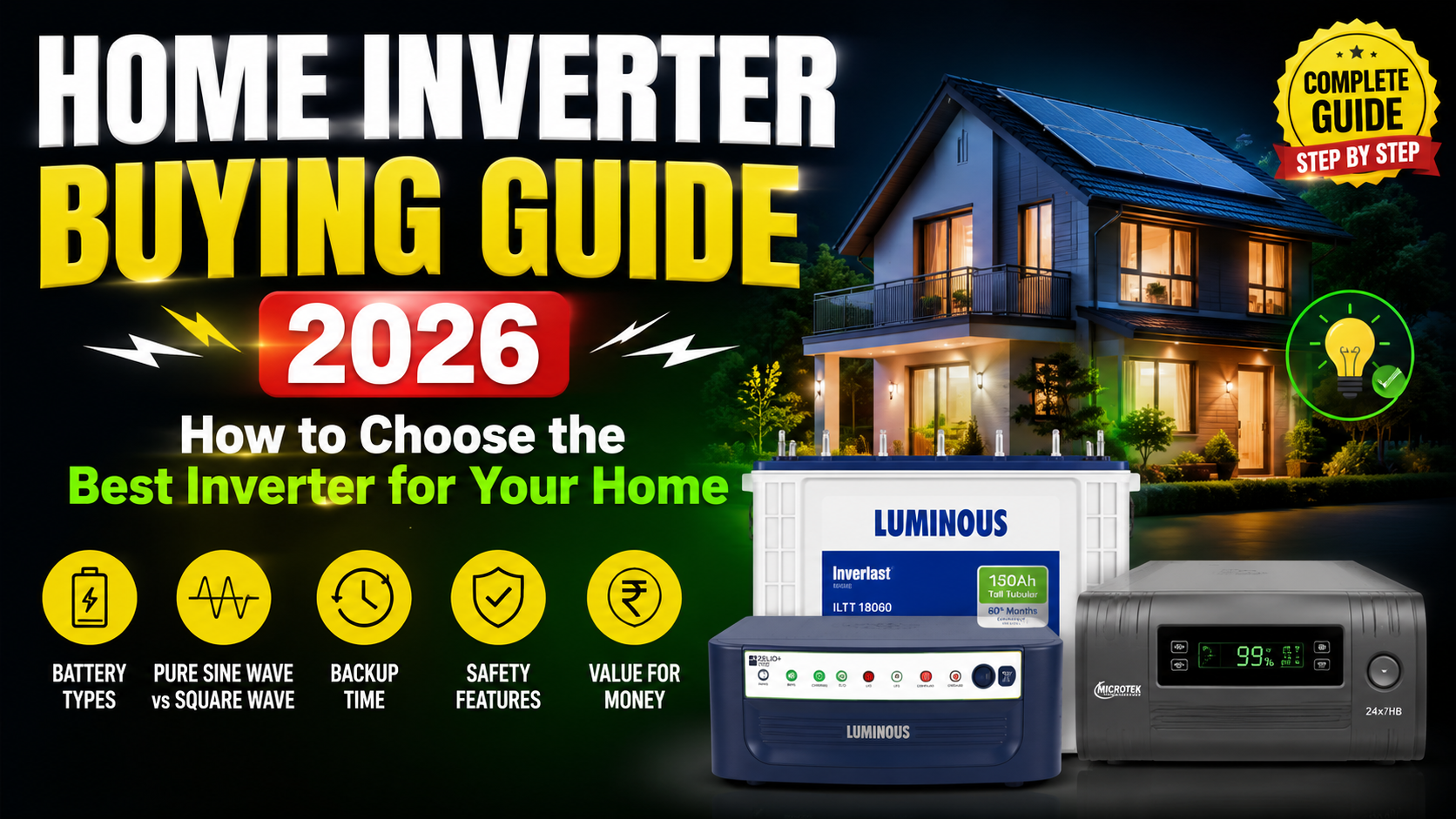
Home Inverter Buying Guide 2026: How to Choose the Best Inverter for Your Home
Home Inverter Buying Guide 2026 – Complete Beginner’s Guide
Are you planning to buy a home inverter in 2026 but feeling confused by terms like Pure Sine Wave, Square Wave, UPS, VA, Battery Capacity, Lithium Battery, Tubular Battery, Solar Inverter, and Smart Inverter?
You’re not alone.
With so many brands like Luminous, V-Guard, Livguard, Microtek, Exide, Genus, Okaya, and Eastman, choosing the right inverter can be overwhelming.
The biggest mistake many buyers make is purchasing an inverter based only on price. Later, they realize it cannot handle the required load or provides only a short backup time.
This complete buying guide will help you understand everything before investing your money.
Buy Best Inverter in Flipkart: Click Here
Check to Buy in Amazon:
Luminous Inverter & Battery Combo 700VA/150Ah Battery:
https://amzn.to/4jtxLW4
Luminous Inverter & Battery Combo 900VA/150Ah Battery:
https://amzn.to/4dGQNat
Exide 1050Va 150Ah Exide Tall Tubular Battery Combo
https://amzn.to/43Frl0l
Microtek 150Ah Inverter Battery
https://amzn.to/3ZGzosu
Microtek Super Power 900 Advanced Digital 800VA/12V Inverter
https://amzn.to/43Xs7Ha
Genus Inverter with Battery Combo 900VA / 12V / 165 Ah
https://amzn.to/43m6EaO
V-Guard Inverter & Battery Combo 650VA/ 12V Inverter,150 Ah
https://amzn.to/3Ho4oap
Livguard Sineverter Pro 700VA/12V Pure Sine Wave Inverter with Livguard 150Ah
https://amzn.to/45xSuVp
What Is a Home Inverter?
A home inverter is a backup power system that automatically supplies electricity from a battery whenever there is a power outage.
A typical inverter system consists of:
- Inverter
- Battery
- Charging Circuit
- Protection System
When electricity is available, the inverter charges the battery.
When power fails, it instantly converts DC battery power into AC electricity and supplies power to your appliances.
Why Should You Buy a Home Inverter?
A quality inverter provides several benefits:
- Continuous power during outages
- Protection for sensitive electronics
- Comfortable living without interruptions
- Reliable backup for work-from-home users
- Better productivity
- Protection against voltage fluctuations (in premium models)
Step 1: Calculate Your Power Requirement
Before buying an inverter, calculate the total wattage of the appliances you want to run.
Example:
| Appliance | Power |
|---|---|
| 4 LED Bulbs | 40W |
| 3 Ceiling Fans | 225W |
| Television | 100W |
| Wi-Fi Router | 15W |
| Laptop | 70W |
Total Load = 450 Watts
Always add a 20–25% safety margin.
Recommended Load:
450W + 25%
≈ 560 Watts
Step 2: Choose the Right Inverter Capacity
Home inverters are rated in VA instead of Watts.
Approximate selection:
600VA
Suitable for:
- 2 Fans
- 3 Lights
- Router
- TV
900VA
Suitable for:
- 3 Fans
- 5 Lights
- TV
- Wi-Fi
- Laptop
1100VA
Ideal for most Indian families.
Supports:
- 4 Fans
- 6 Lights
- Television
- Router
- Laptop
1500VA
Perfect for larger homes.
Can run:
- Multiple Fans
- LED Lights
- Television
- Desktop
- Refrigerator (selected models)
- Additional appliances
2000VA+
Recommended for:
- Large homes
- Offices
- Shops
- Heavy load requirements
Step 3: Choose the Right Battery
The battery determines backup time.
Common capacities include:
- 100Ah
- 120Ah
- 150Ah
- 180Ah
- 200Ah
Higher Ah means longer backup.
Which Battery Type Is Best?
Flat Plate Battery
Advantages:
- Lower cost
- Faster charging
Disadvantages:
- Shorter lifespan
- Higher maintenance
Best for:
Areas with fewer power cuts.
Tall Tubular Battery
Advantages:
- Long life
- Better backup
- Excellent performance during long power cuts
- Low maintenance
Disadvantages:
- Higher price
Recommended for most homes.
Lithium-ion Battery
Advantages:
- Lightweight
- Fast charging
- Maintenance-free
- Long lifespan
- Smart monitoring
Disadvantages:
- Expensive
Best for premium users.
Step 4: Pure Sine Wave vs Square Wave
Square Wave Inverter
Pros
- Low cost
Cons
- Noisy fans
- Poor performance
- Unsafe for modern electronics
- Can reduce appliance life
Recommended only for basic loads.
Pure Sine Wave Inverter
Pros
- Smooth electricity output
- Safe for TVs
- Safe for refrigerators
- Safe for computers
- Quiet operation
- Better efficiency
This is the recommended choice for almost every home.
Step 5: Decide the Required Backup Time
Typical backup requirements:
2 Hours
100–120Ah Battery
Suitable for:
Small apartments
4 Hours
150Ah Battery
Suitable for:
Average family
6–8 Hours
180Ah–220Ah Battery
Suitable for:
Areas with frequent power cuts.
Step 6: Check Charging Speed
Some premium inverters include:
- Fast charging mode
- Intelligent charging
- Battery health optimization
These features increase battery life and reduce charging time.
Step 7: Important Safety Features
Always choose an inverter with:
- Overload Protection
- Short Circuit Protection
- Reverse Polarity Protection
- Battery Deep Discharge Protection
- Automatic Restart
- Intelligent Cooling Fan
- Thermal Protection
Step 8: Smart Features
Modern inverters now offer:
- LCD Display
- Battery Percentage
- Load Percentage
- Mobile App Control
- Wi-Fi Monitoring
- Fault Alerts
- Battery Health Report
These features make monitoring easier.
Step 9: Can You Run a Refrigerator?
Yes—but only if the inverter has sufficient capacity.
For refrigerators, consider:
- 1500VA or higher inverter
- High-capacity battery
- Pure Sine Wave technology
Avoid overloading the inverter.
Step 10: Can You Run an Air Conditioner?
Most standard home inverters are not designed to run 1.5 Ton or 2 Ton air conditioners.
Running an AC typically requires:
- High-capacity inverter system
- Multiple batteries
- Hybrid or solar inverter
- Proper load calculation
For regular home use, it’s better to use the inverter for essential appliances only.
Which Inverter Is Best for Different Home Sizes?
1 BHK
Recommended:
- 900VA Inverter
- 150Ah Battery
2 BHK
Recommended:
- 1100VA–1500VA Inverter
- 150Ah–180Ah Battery
3 BHK
Recommended:
- 1500VA–2000VA Inverter
- 180Ah–220Ah Battery
Best Home Inverter Brands in India (2026)
Some of the most trusted brands include:
- Luminous
- V-Guard
- Livguard
- Exide
- Microtek
- Genus
- Okaya
- Eastman
When choosing a brand, consider:
- Warranty
- After-sales service
- Service center availability
- Spare parts support
- Customer reviews
Common Mistakes to Avoid
- Buying only based on price
- Ignoring total load calculation
- Choosing a low-capacity battery
- Buying a Square Wave inverter for modern appliances
- Ignoring warranty and service support
- Overloading the inverter
- Using old or mismatched batteries
Frequently Asked Questions (FAQs)
Which inverter is best for home use?
A Pure Sine Wave inverter paired with a Tall Tubular battery is the best choice for most households because it offers clean power, better appliance safety, and longer battery life.
What inverter capacity is suitable for a typical family?
For most Indian homes, a 1100VA to 1500VA inverter with a 150Ah or 180Ah battery provides an excellent balance of backup time and performance.
Which battery lasts longer?
Tall Tubular batteries generally last longer than Flat Plate batteries and are ideal for areas with frequent power cuts.
Can an inverter run a refrigerator?
Yes, provided the inverter has adequate capacity and uses Pure Sine Wave technology.
Can an inverter run an air conditioner?
Most standard home inverters cannot efficiently power a 1.5-ton AC. A dedicated high-capacity or hybrid inverter system is usually required.
Final Verdict
Buying the right home inverter is not just about choosing the cheapest option—it’s about selecting a system that matches your home’s power needs, backup expectations, and future requirements.
For most families in India, a Pure Sine Wave inverter with a 150Ah or 180Ah Tall Tubular battery offers the best combination of performance, reliability, safety, and long-term value.
Before making your purchase, calculate your total load, select the correct inverter capacity, choose a reliable battery, and always invest in a trusted brand with good after-sales service. A well-chosen inverter will provide years of dependable backup power and protect your essential appliances during every power outage.